GFCI Receptacle vs GFCI Breaker: Which to Spec
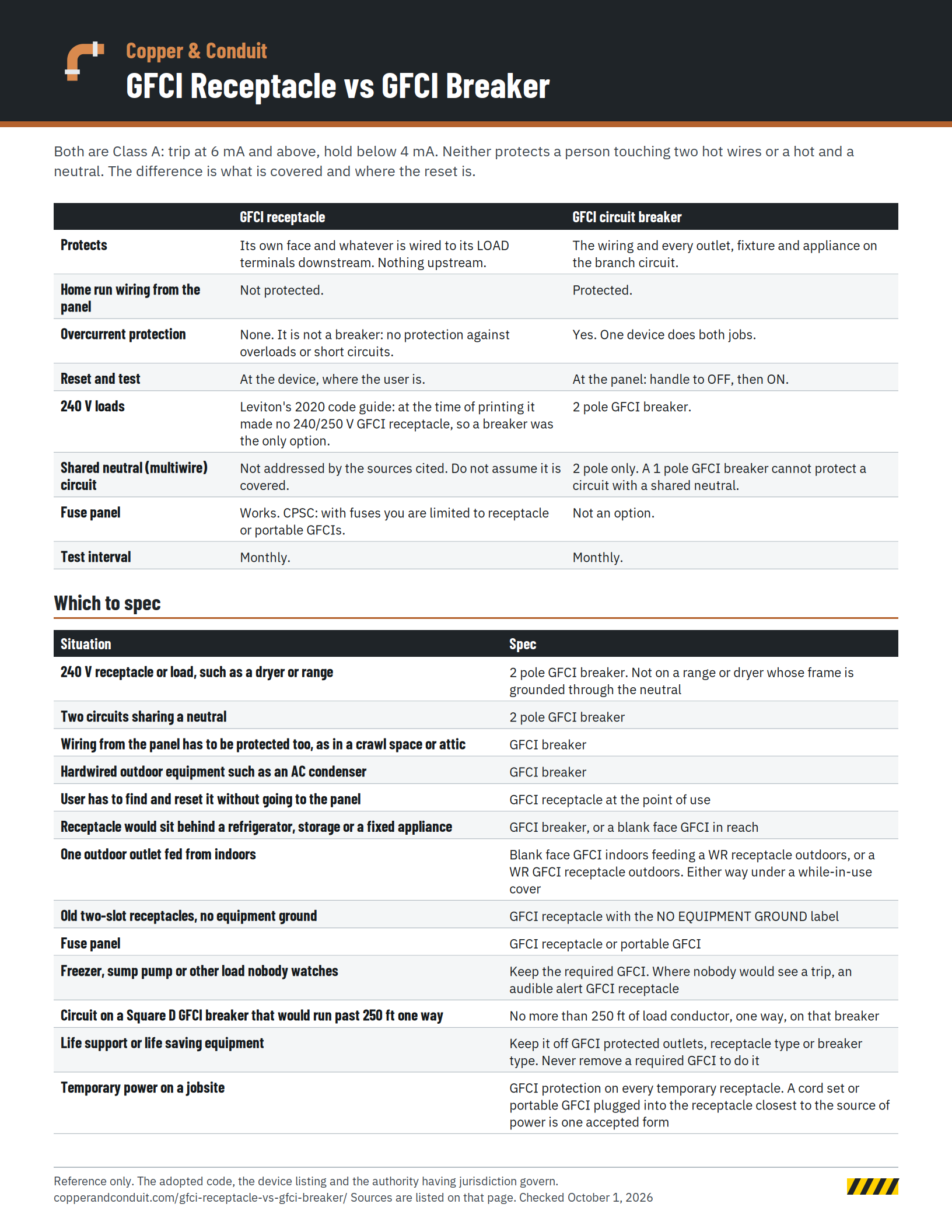
Same trip level, different coverage. A Class A GFCI trips at 6 milliamperes whether it sits in the wall or in the panel. The receptacle protects from its own face downstream. The breaker protects the whole circuit from the panel out. Spec by what has to be covered and where the reset has to be reached.
- Answers
- Receptacle type or breaker type for this circuit?
- Format
- Selection guide
- Sources
- 34 cited
- Last checked
Side by side
| GFCI receptacle | GFCI circuit breaker | |
|---|---|---|
| Protects | Its own face and whatever is wired to its LOAD terminals downstream. Nothing upstream.15 5 | The wiring and every outlet, fixture and appliance on the branch circuit.5 |
| Home run wiring from the panel | Not protected.28 | Protected.28 |
| Overcurrent protection | None. It is not a breaker: no protection against overloads or short circuits.15 | Yes. One device does both jobs.1 5 |
| Reset and test | At the device, where the user is.34 | At the panel: handle to OFF, then ON.25 |
| 240 V loads | Leviton’s 2020 code guide: at the time of printing it made no 240/250 V GFCI receptacle, so a breaker was the only option.20 | 2 pole GFCI breaker.26 |
| Shared neutral (multiwire) circuit | Not addressed by the sources cited. Do not assume it is covered. | 2 pole only. A 1 pole GFCI breaker cannot protect a circuit with a shared neutral.1 26 |
| Ratings | 15 A and 20 A, 125 V, with 20 A feed-through.18 15 | 1 pole and 2 pole. Siemens lists 15 to 30 A in 1 pole and up to 60 A in 2 pole.29 |
| Fit | A standard outlet box. Leviton’s consumer sheet: if the box holds more than four wires, or a cable with more than two wires, not counting grounds, contact a qualified electrician.5 15 | Must be the breaker listed or classified for that panel.2 1 |
| Damp and wet locations | Must be listed and marked weather resistant (WR). In a wet location it goes under a cover or hood suitable for wet locations.15 1 | The GFCI electronics stay in the panel. The receptacle it feeds still has to be weather resistant (WR) and in an enclosure suitable for the location.1 |
| Fuse panel | Works. CPSC: with fuses you are limited to receptacle or portable GFCIs.6 | Not an option.6 |
| Test interval | Monthly.15 5 | Monthly.25 2 |
Which to spec
| Situation | Spec | Why |
|---|---|---|
| 240 V receptacle or load, such as a dryer or range | 2 pole GFCI breaker. Not on a range or dryer whose frame is grounded through the neutral | Leviton’s 2020 code guide: at the time of printing it made no 240/250 V GFCI receptacle, so a breaker was the only option. The breaker must switch both hot conductors to provide protection. Square D and Eaton: do not connect a GFCI breaker to a range or dryer whose frame is grounded through the neutral conductor.20 25 31 |
| Two circuits sharing a neutral | 2 pole GFCI breaker | UL: a two-wire GFCI breaker is not suitable for a multiwire branch circuit. Square D: 1 pole GFCIs must be installed on independent circuits.1 26 |
| Wiring from the panel has to be protected too, as in a crawl space or attic | GFCI breaker | The receptacle leaves the wiring upstream of it unprotected.28 5 |
| Hardwired outdoor equipment such as an AC condenser | GFCI breaker | There is no receptacle to put a device in. Schneider: this protection is typically delivered by a GFCI breaker in the panel. UL: some HVAC equipment was incompatible with standard GFCIs, and high frequency GFCIs are now coming to market.28 4 |
| User has to find and reset it without going to the panel | GFCI receptacle at the point of use | Reset button on the device. An NFPA blog: many service calls turn out to be a tripped GFCI receptacle the homeowner did not know about or could not locate.34 12 |
| Receptacle would sit behind a refrigerator, storage or a fixed appliance | GFCI breaker, or a blank face GFCI in reach | The code requires the GFCI in a readily accessible location. The panel stays accessible.21 28 17 |
| One outdoor outlet fed from indoors | Blank face GFCI indoors feeding a WR receptacle outdoors, or a WR GFCI receptacle outdoors. Either way under a while-in-use cover | Leviton lists the blank face unit for mounting indoors to protect an outdoor outlet downstream. UL: receptacles for wet and damp locations are the ones marked Weather Resistant or WR.17 15 24 1 |
| Old two-slot receptacles, no equipment ground | GFCI receptacle with the NO EQUIPMENT GROUND label | CPSC: a GFCI may replace an ungrounded two-slot receptacle, with the supplied label NO EQUIPMENT GROUND GFCI PROTECTED. A GFCI works without a ground.5 |
| Fuse panel | GFCI receptacle or portable GFCI | No breaker to change.6 |
| Freezer, sump pump or other load nobody watches | Keep the required GFCI. Where nobody would see a trip, an audible alert GFCI receptacle | Leviton: a trip that goes undetected can shut down freezers and sump pumps. It sells an audible alert GFCI for garages and basements.20 17 |
| Circuit on a Square D GFCI breaker that would run past 250 ft one way | No more than 250 ft of load conductor, one way, on that breaker | Square D: no more than 250 ft of load conductor for the total one-way run, to minimize nuisance tripping. No other maker opened here states a length.25 27 |
| Life support or life saving equipment | Keep it off GFCI protected outlets, receptacle type or breaker type. Never remove a required GFCI to do it | A trip cuts the power. Leviton: do not install a GFCI receptacle on a circuit that powers life support equipment, and do not plug life saving devices into receptacles it protects. Hubbell says the same for critical care patient areas. A GFCI breaker shuts the circuit off the same way. Where the code requires GFCI protection, the equipment needs a different circuit; that is an electrician’s call.15 33 |
| Temporary power on a jobsite | GFCI protection on every temporary receptacle. A cord set or portable GFCI plugged into the receptacle closest to the source of power is one accepted form | OSHA’s general industry rule for temporary wiring accepts cord sets and devices incorporating the GFCI when connected to the receptacle closest to the source of power. Its construction eTool lists receptacle, portable and cord-connected types.8 9 |
What Class A means
- Trip level: a Class A device must trip at 6 milliamperes of ground-fault current and above and hold below 4 milliamperes. UL’s guide gives the band as 4 through 6 mA. Breakers are labeled 5 mA. All three describe one rule.26 1 25
- Speed: OSHA describes a GFCI shutting off power in as little as 1/40 of a second.9
- It works by comparing current out and current back, so it works without an equipment ground.5
- It does not protect against line contact. OSHA: a person holding two hot wires, or a hot and a neutral, is not protected. Square D prints the same limit on its breaker instructions.9 25
- A shock is still possible. CPSC: you may receive a painful shock, but you should not be electrocuted.6
- 30 mA is not people protection. Equipment protection devices that trip at 30 mA guard heat trace and equipment. Square D: they are not designed to protect people from electrical shock. Do not substitute one where a GFCI is required.26 3
LINE and LOAD
A GFCI receptacle has two sets of terminals. LINE takes power from the panel. LOAD passes protected power to the receptacles after it. Leviton’s instruction sheet draws it as three receptacles on one circuit: a GFCI in the first position protects the two after it; a GFCI in the last position protects neither of the two before it. Standard receptacles protected this way get a GFCI PROTECTED OUTLET sticker.15
GFCI receptacles made after June 29, 2015 must have two features that older ones may lack, under a revision to UL 943 that the makers date to that day. Self test: the device checks its own ability to trip, and on failure it denies power, trips, or signals. Miswire lockout: fed through its LOAD terminals, the device will not reset and will not supply power. Stock made before the date could still be sold and installed. Leviton still says to test self-test models monthly.16 32 30 17
The breaker has to match the panel
- UL lists a breaker for use in panelboards intended and marked for its use. A UL Classified breaker is the exception, and only in the specific panelboards on its compatibility list.2 1
- Schneider: Homeline and QO use different load center designs and are not interchangeable.28
- A 2 pole GFCI breaker on a 240 V only load needs no load neutral, but Siemens notes the breaker’s white pigtail must still land on the panel neutral for the device to work.29
- Square D: do not connect its GFCI breaker to a range or dryer whose frame is grounded through the neutral conductor.25
Where the code requires GFCI protection
The NEC names the locations. It does not say which device to use: NFPA notes the code does not necessarily specify where the GFCI itself has to be installed. The 2020 text sets one condition: a readily accessible location. The table is an outline, not the full list: 210.8(C), (D) and (E), Article 680 for pools and 625.54 for EV charging add more, each rule has exceptions, and states amend the text. Name the edition before you quote a rule. As of August 3, 2026, NFPA shows the 2026 NEC in effect in 6 states, the 2023 NEC in 20, the 2020 NEC in 15, the 2017 NEC in 3 and the 2008 NEC in 2.12 21 28 13
| Rule | Edition | What it covers |
|---|---|---|
| 210.8(A) dwelling units | 2020 | Bathrooms; garages and accessory buildings; outdoors; crawl spaces; basements; kitchen countertop receptacles; within 6 ft of sinks; boathouses; within 6 ft of bathtubs and shower stalls; laundry areas; indoor damp and wet locations.20 |
| 210.8(A) voltage | 2020 | Expanded, in the listed locations, to all 125 volt through 250 volt receptacles on single-phase branch circuits rated 150 volts or less to ground. Leviton’s example: the 240 volt, 30 ampere dryer receptacle now needs GFCI protection.20 |
| 210.8(A) kitchens | 2023 | All kitchen receptacles, not only those serving countertops.23 |
| 210.8(B) other than dwelling units | 2020 | In the locations listed in 210.8(B)(1) through (12): 125 through 250 volt receptacles on single-phase branch circuits rated 150 volts or less to ground and 50 amperes or less, and all receptacles on three-phase branch circuits rated 150 volts or less to ground and 100 amperes or less.21 |
| 210.8(F) outdoor outlets, dwellings | 2020, 2023 | Outdoor outlets on single-phase branch circuits of 150 volts or less to ground and 50 amperes or less, hardwired equipment included. The exception for listed HVAC equipment, added to the 2020 NEC by TIA and carried into the 2023 and 2026 editions, expired September 1, 2026.22 14 4 |
| 210.8(F) | 2026 | UL describes the 2026 text as 60 amperes or less.4 |
OSHA
- Construction, 29 CFR 1926.404(b)(1): all 120 volt, single-phase, 15 and 20 ampere receptacle outlets that are not part of the permanent wiring and are in use by employees need GFCI protection, or the employer runs an assured equipment grounding conductor program.7
- General industry, 29 CFR 1910.304(b)(3): 125 volt, 15 and 20 ampere receptacles in bathrooms and on rooftops need GFCI protection. On temporary wiring for construction-like work, 15, 20 and 30 ampere receptacles need it.8
- The end of an extension cord counts. OSHA: a cord connector on an extension cord set is a receptacle outlet if the cord set is used for temporary power.8
Testing and failure
- Monthly, both types. CPSC adds: after installation and after a power failure.5
- Use the TEST button with a load plugged in. OSHA prefers that over a plug-in GFCI tester.10
- Receptacle: press TEST. The plugged-in load must go dead. CPSC: if the light does not go out, the GFCI is not working or was not installed correctly; contact a qualified electrician. Then press RESET. If it will not reset, it has to be replaced.5 15
- Breaker: press TEST. If the handle does not move to the tripped position, Square D says turn the breaker off and contact a qualified electrician.25
- The TEST and RESET buttons are not a switch. UL: they are not intended as ON/OFF controls for motors or other loads.1
- Indicator lights differ by brand. On Leviton a red light that stays on after TEST and RESET means replace. Hubbell uses a flashing red light for end of life. Read the sheet for the device in the wall.19 32
A GFCI that trips or will not reset is a diagnosis job, not a spec job. Our sister site walks it step by step: GFCI won’t reset at Vent, Valve & Volt.
Sources
- UL. Guide Information for Electrical Equipment: The White Book 2015-16, categories KCXS, DKUY, DIXF, DIYA, RTRT. 2015.
- UL. Molded Case Circuit Breakers Marking and Application Guide. 2016.
- UL. Understanding Ground Fault and Leakage Current Protection. January 2009.
- UL Solutions. The Coordination Between Model Codes and Standards: 2026 National Electrical Code. Read October 1, 2026.
- U.S. Consumer Product Safety Commission. CPSC Fact Sheet: What Is a GFCI? Publication 099. September 2010.
- U.S. Consumer Product Safety Commission. GFCIs Fact Sheet, CPSC Document #99 (1996 edition, archived copy). 1996.
- OSHA. 29 CFR 1926.404(b)(1), Wiring design and protection (construction). eCFR, current as of September 30, 2026.
- OSHA. 29 CFR 1910.304(b)(3), Wiring design and protection. eCFR, current as of September 30, 2026.
- OSHA. Construction eTool: Electrical Incidents, Ground-Fault Circuit Interrupters (GFCI). Read October 1, 2026.
- OSHA. Standard interpretations on ground fault circuit interrupters, with Technical Note 91-1. February 1992.
- Electrical Safety Foundation International (ESFI). Ground Fault Circuit Interrupters (GFCI). Revised June 2023.
- NFPA. 5 Ways to Check Ground-Fault Circuit Interrupters to Help Ensure Continued Safety in Homes (NFPA Today). August 10, 2021.
- NFPA. NEC Enforcement Maps. As of August 3, 2026.
- NFPA. Tentative Interim Amendment TIA 23-3 to NFPA 70, 2023 edition, 210.8(F). August 12, 2022.
- Leviton. Instruction sheet: Installing and Testing a GFCI Receptacle (GFNL1, GFNL2). 2017.
- Leviton. Flyer G-9465: New UL GFCI Standard, self-test models. 2015.
- Leviton. Brochure: SmartlockPro Self-Test GFCIs, G-8346C. 2015.
- Leviton. GFCI Product Bulletin: SmartlockPro Self-Test GFCIs. 2024.
- Leviton. LED Indicator Light Diagnosis for GFCIs. 2025.
- Leviton. Captain Code 2020: 210.8(A) dwelling unit GFCI protection, reprinted from the 2020 NEC. 2020.
- Leviton. Captain Code 2020: 210.8(B) other than dwelling units, reprinted from the 2020 NEC. 2020.
- Leviton. Captain Code 2020: 210.8(D), (E) and (F), reprinted from the 2020 NEC. 2020.
- Leviton. Captain Code 2023: 210.8(A) kitchens. 2023.
- Leviton. GFCI Outlets and Receptacles (category page). Read October 1, 2026.
- Schneider Electric (Square D). Instruction Bulletin 48840-058-03: Two-Pole Homeline Circuit Breaker and GFCI. June 2019.
- Schneider Electric (Square D). Catalog 0730CT9801R1/08: QO and QOB Miniature Circuit Breakers. 2008.
- Schneider Electric. Digest, Section 1: Load Centers. August 2021.
- Schneider Electric. Residential GFCI protection: NEC guide for electricians. August 4, 2026.
- Siemens. Specification Sheet: Ground Fault Circuit Interrupters, Class A 5mA. January 2023.
- Siemens. White Paper: 2015 UL 943 Update, GFCI Self Test Feature. June 2015.
- Eaton. Instruction Leaflet IL003022EN: BR, CL, CH and QB AFCI and GFCI breakers. November 2018.
- Hubbell. Brochure WLBG001: AUTOGUARD Self Test Ground Fault Receptacles. 2015.
- Hubbell Wiring Device-Kellems. Catalog, Section L: GFCI products. 2017.
- Legrand, Pass & Seymour. Product sheet 2097HGTRPIRED. Read October 1, 2026.