Surge Protector Ratings: What the Numbers on the Label Mean
The joule figure sells the strip. No standard test defines it. The markings that mean something are the UL 1449 ones: VPR, MCOV, nominal discharge current, SCCR and SPD Type.
- Answers
- Which numbers on a surge protector label mean something?
- Format
- Selection guide
- Sources
- 26 cited
- Last checked
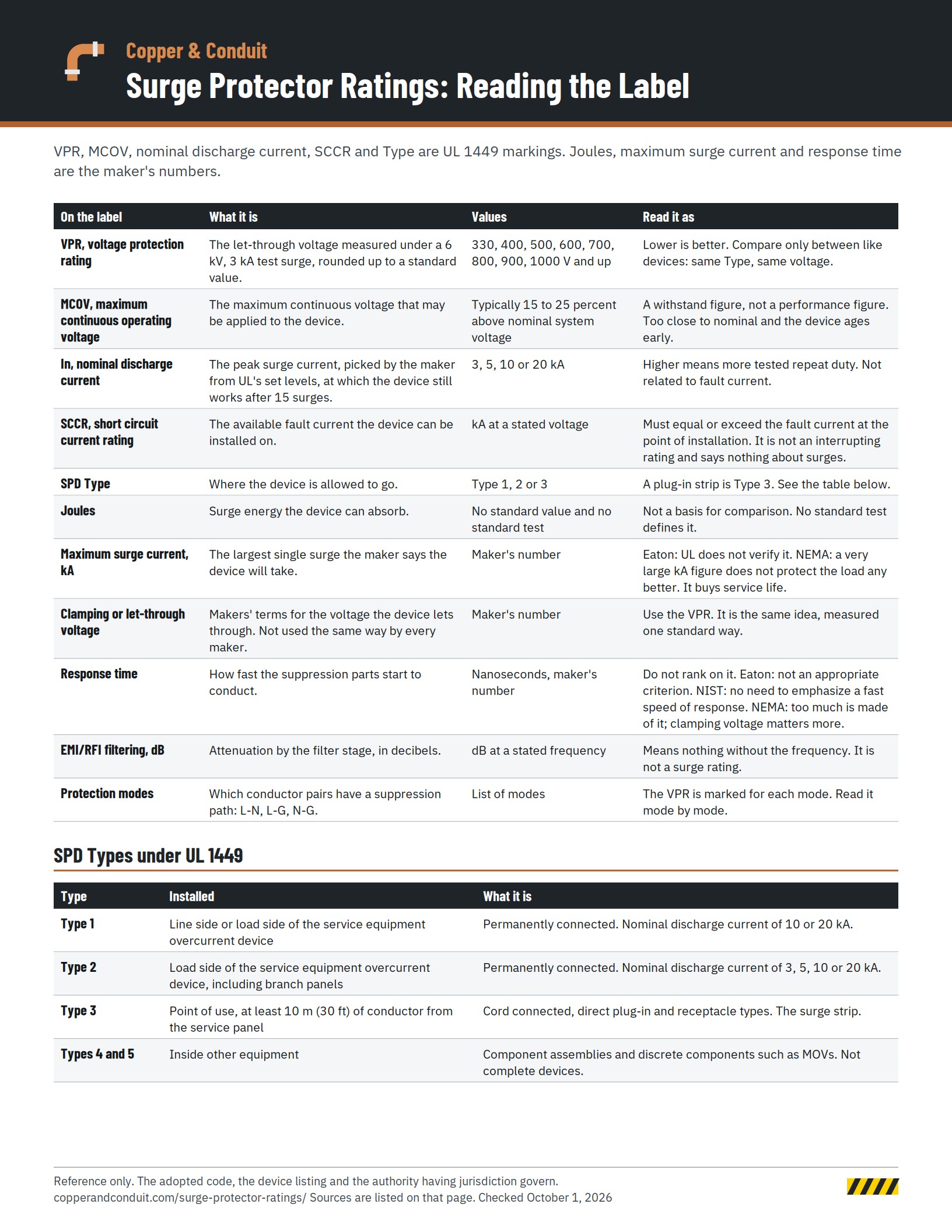
The label, term by term
| On the label | What it is | Values | Read it as |
|---|---|---|---|
| VPR, voltage protection rating | The let-through voltage measured under a 6 kV, 3 kA test surge, rounded up to a standard value.1 2 | 330, 400, 500, 600, 700, 800, 900, 1000 V and up17 | Lower is better. Compare only between like devices: same Type, same voltage.26 1 |
| MCOV, maximum continuous operating voltage | The maximum continuous voltage that may be applied to the device.11 | Typically 15 to 25 percent above nominal system voltage1 | A withstand figure, not a performance figure. Too close to nominal and the device ages early.4 |
| In, nominal discharge current | The peak surge current, picked by the maker from UL’s set levels, at which the device still works after 15 surges.11 2 | 3, 5, 10 or 20 kA1 | Higher means more tested repeat duty. Not related to fault current.4 |
| SCCR, short circuit current rating | The available fault current the device can be installed on.1 | kA at a stated voltage | Must equal or exceed the fault current at the point of installation. It is not an interrupting rating and says nothing about surges.1 |
| SPD Type | Where the device is allowed to go.8 | Type 1, 2 or 3 | A plug-in strip is Type 3. See the table below.6 |
| Joules | Surge energy the device can absorb.5 7 | No standard value and no standard test1 | Not a basis for comparison. No standard test defines it. |
| Maximum surge current, kA | The largest single surge the maker says the device will take.18 | Maker’s number | Eaton: UL does not verify it. NEMA: a very large kA figure does not protect the load any better. It buys service life.19 1 |
| Clamping or let-through voltage | Makers’ terms for the voltage the device lets through. Not used the same way by every maker.5 24 | Maker’s number | Use the VPR. It is the same idea, measured one standard way.1 |
| Response time | How fast the suppression parts start to conduct. | Nanoseconds, maker’s number | Do not rank on it. Eaton: not an appropriate criterion. NIST: no need to emphasize a fast speed of response. NEMA: too much is made of it; clamping voltage matters more.18 7 1 |
| EMI/RFI filtering, dB | Attenuation by the filter stage, in decibels.1 6 | dB at a stated frequency | Means nothing without the frequency. It is not a surge rating.1 |
| Protection modes | Which conductor pairs have a suppression path: L-N, L-G, N-G.5 | List of modes | The VPR is marked for each mode. Read it mode by mode.19 |
Joules: why the big number says little
- NEMA: there is no clear standard for SPD energy measurement, and comparing joule ratings can be misleading.1
- NEMA: a lower joule figure can be the better device if it comes from a lower clamping voltage.1
- NIST calls the joule rating a simplified measure and notes that many specifications show total joules across the three wiring combinations instead of a breakdown.7
- Eaton: IEEE and NEMA do not recommend the use of joule ratings for SPD comparison.18
- The makers who print it say higher is better. Tripp Lite: typically, the higher the joule rating, the greater the protection provided. That is the maker’s position, not a tested rating.24
VPR is the number to compare
VPR replaced the older suppressed voltage rating, SVR, when UL 1449 Third Edition took effect. Eaton dates it: published September 2006, compliance required by September 2009. The VPR test uses six times the surge current of the old SVR test, so the two numbers do not compare. An old strip marked 330 V SVR and a new one marked 500 V VPR are not ranked by those numbers.16
The rating is rounded up to a fixed list. Eaton’s example: a measured let-through of 610 V earns a VPR of 700 V. NIST’s 2001 booklet, written about the older clamping voltage figure and not about VPR, says 330 volts is embedded in the UL standard values but is not a requirement, and that somewhat higher clamping voltages, 400 volts or more, may be sufficient for electronic appliances. Those are pre-VPR numbers: do not read them as VPR values.17 7 16
No VPR on the device: Eaton says to assume it is not UL 1449 listed.19
SPD Types: where each one goes
| Type | Installed | What it is |
|---|---|---|
| Type 1 | Line side or load side of the service equipment overcurrent device | Permanently connected. Nominal discharge current of 10 or 20 kA.8 6 |
| Type 2 | Load side of the service equipment overcurrent device, including branch panels | Permanently connected. Nominal discharge current of 3, 5, 10 or 20 kA.8 6 |
| Type 3 | Point of use, at least 10 m (30 ft) of conductor from the service panel | Cord connected, direct plug-in and receptacle types. The surge strip.8 6 |
| Types 4 and 5 | Inside other equipment | Component assemblies and discrete components such as MOVs. Not complete devices.8 20 |
The 10 m distance does not count the cord supplied with the device. NEMA notes a Type 3 device that earns a nominal discharge current rating of 3 kA or more is evaluated as a Type 2 and is not held to the distance.8 6
Power strip or surge protector
- A power strip is a relocatable power tap, covered by UL 1363. A surge protective device is covered by UL 1449. A strip that includes surge protection has to meet both.9 10 8
- How to tell: look for a VPR marking and a testing laboratory mark such as UL, ETL or CSA. NIST and CPSC both say to check for the mark. Older units say transient voltage surge suppressor or TVSS; NEMA dates the change of name to 2009.7 13 3
- No VPR, no surge rating you can rely on. Outlets and a switch are not protection.19
When it wears out
- The suppression parts wear. NEMA: sustained overvoltages are the leading cause of SPD failures.1
- NIST: indications are not standardized. At end of life some units cut power to the outlets. Others drop the failed part and keep passing power with no protection.7
- A protected light that has gone out means replace the unit. A grounded light reports the outlet wiring, not the surge capacity.24 25
Rules of use
- Plug the strip straight into a permanently installed receptacle. OSHA, citing the UL listing: not series-connected to other strips, not connected to extension cords.12
- Not for heavy loads. OSHA: power strips are not designed for high power loads such as space heaters, refrigerators and microwave ovens. CPSC: plug a space heater into a wall outlet, never a power strip.12 14
- OSHA also notes UL does not intend power strips for construction sites.12
What the code asks for
A strip is not the whole job. The 2020 NEC added 230.67: services supplying dwelling units must have a surge protective device, Type 1 or Type 2, integral to or right beside the service equipment. The 2023 edition extended it to dormitory units, hotel and motel guest rooms and suites, and patient sleeping rooms in nursing homes and limited-care facilities, and set a minimum nominal discharge current of 10 kA. The installation rules sit in Article 242, which replaced Articles 280 and 285 in 2020. Adoption varies by state.22 21 23
Where the surges come from is why both layers exist. NEMA’s Surge Protection Institute puts 80 percent of surges as generated inside the building. ESFI quotes NEMA at 60 to 80 percent.1 15
How to spec a plug-in unit
- Confirm it is a surge protective device: VPR marked, testing laboratory mark present.19 7
- Compare VPR between like units, mode by mode. Lower is better.1 26
- Do not rank on joules or response time.1 18
- Pick a unit with a protection indicator, and replace the unit when it goes out. ESFI recommends an indicator light or alarm.15
- No source we opened names a VPR you must buy. UL 1449 itself does not evaluate whether a VPR is adequate to protect a given load.8
Sources
- NEMA Surge Protection Institute. FAQs. Read October 1, 2026.
- NEMA Surge Protection Institute. UL 1449: Surge Protective Devices (SPD). Read October 1, 2026.
- NEMA Surge Protection Institute. What Are SPDs. Read October 1, 2026.
- NEMA Surge Protection Institute. How SPDs work. Read October 1, 2026.
- NEMA Surge Protection Institute. Glossary. Read October 1, 2026.
- NEMA Surge Protection Institute. Surge Protective Device (SPD) Type Application Considerations. January 31, 2013.
- National Institute of Standards and Technology. Surges Happen! How to Protect the Appliances in Your Home, NIST Special Publication 960-6. May 2001.
- UL Standards & Engagement. UL 1449, Surge Protective Devices, Edition 5: scope. Published January 8, 2021.
- UL Standards & Engagement. UL 1363, Relocatable Power Taps, Edition 6: scope. Published July 13, 2023.
- UL Solutions. Power Strips Testing and Certification. Read October 1, 2026.
- UL. Guidelines for the Surge Protective Devices Used in ICP, UL Certification Requirement Decision. July 2017.
- OSHA. Standard interpretation: Compliance requirements for relocatable power taps or power strips. November 18, 2002.
- U.S. Consumer Product Safety Commission. CPSC Warns Consumers About Faulty Extension Cords, Power Strips and Surge Protectors. February 24, 1999.
- U.S. Consumer Product Safety Commission. There's a Chill in the Air: Stay Warm Safely. January 22, 2025.
- Electrical Safety Foundation International (ESFI). Surge and Protect. Revised August 2021.
- Eaton. UL 1449 3rd Edition, Key Changes, PCT283136. June 2011.
- Eaton. Surge protection (SPD) products, integrated applications, Design Guide DG158003EN. February 2022.
- Eaton. Eaton's guide to surge suppression, application notes, SA01005003E. 2022.
- Eaton. Summary of application UL and IEEE standards for surge protection devices, White Paper WP158005EN. March 2025.
- Mersen. Surge Protection Note 6: UL 1449 4th Edition Location and/or Type Designations. 2018.
- Mersen. NFPA 70, National Electrical Code (surge protection requirements, 2023 edition). Read October 1, 2026.
- Leviton. National Electrical Code (NEC) Requirements Related to Surge Protection. Read October 1, 2026.
- Schneider Electric. 2020 NEC Changes (Codes and Standards presentation). February 5, 2020.
- Tripp Lite. White paper: Protect Electronic Equipment from Damaging Power Surges and Line Noise Interference. Undated.
- Belkin. Official Support: 6 Outlet Power Surge Protector, Frequently Asked Questions. Read October 1, 2026.
- Fire Protection Research Foundation. Data Assessment for Electrical Surge Protection Devices, Phase 1 Final Report. October 2014.