Extension Cord Gauge by Amps and Length: The Chart
Gauge is the number that matters. Lower number, thicker wire, more load. Match the cord to the amperes on the nameplate and the total length of the run. An undersized cord drops voltage and runs hot.
- Answers
- What gauge cord does this load need at this length?
- Format
- Spec chart
- Sources
- 27 cited
- Last checked
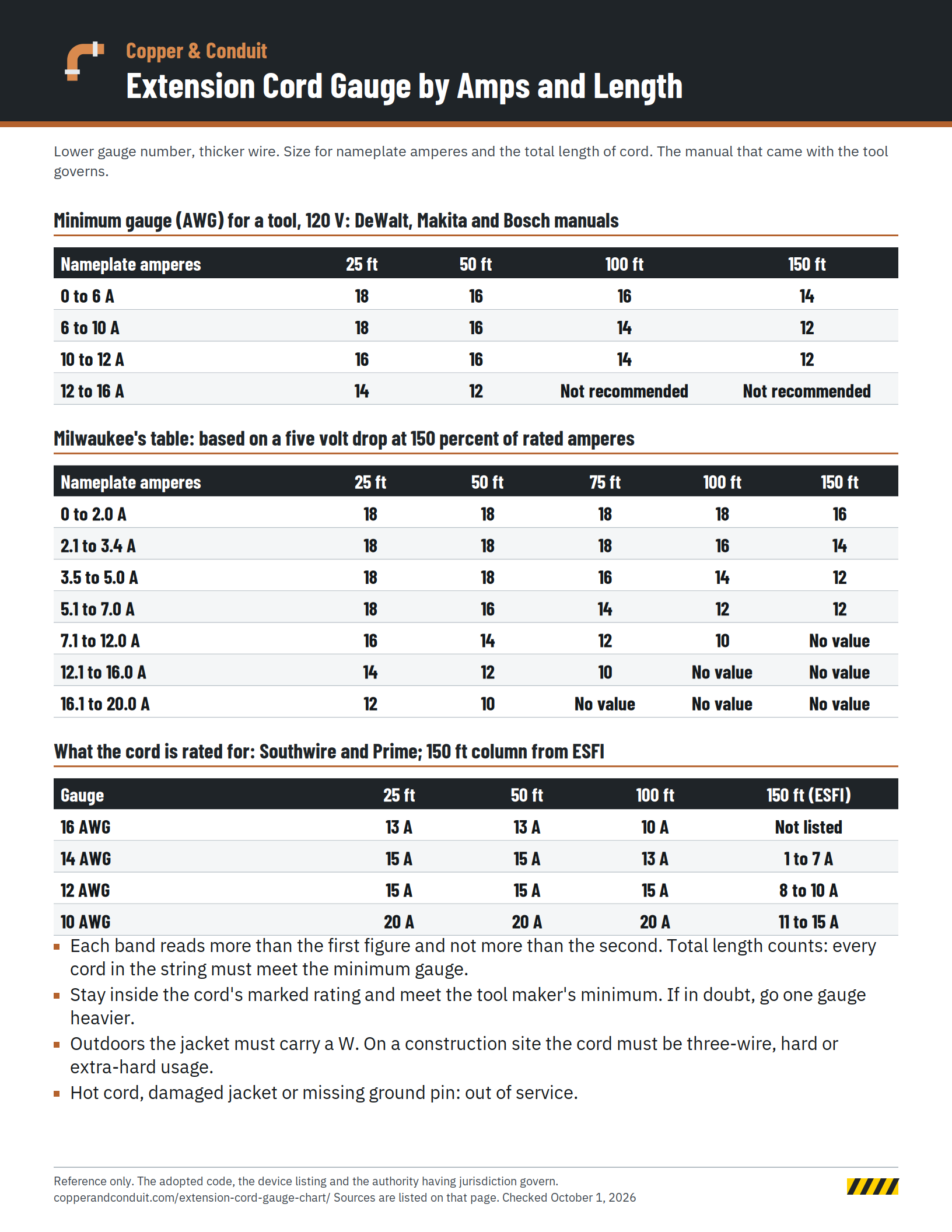
Minimum gauge for a tool, by amperes and length
| Nameplate amperes | 25 ft | 50 ft | 100 ft | 150 ft |
|---|---|---|---|---|
| 0 to 6 A | 18 | 16 | 16 | 14 |
| 6 to 10 A | 18 | 16 | 14 | 12 |
| 10 to 12 A | 16 | 16 | 14 | 12 |
| 12 to 16 A | 14 | 12 | Not recommended | Not recommended |
Length is the total length of cord. Each band reads more than the first figure and not more than the second: a 12 A tool sits in the 10 to 12 A row. DeWalt prints a 240 V row with every length doubled: 50, 100, 200 and 300 ft for the same four columns. Bosch starts its table at 3 A, splits 6 to 10 A into two bands with the same values, and prints a dash where DeWalt and Makita print Not Recommended.1 2 3
DeWalt prints three rules with the table: an undersized cord will cause a drop in line voltage resulting in loss of power and overheating; when more than one extension makes up the total length, each one must contain at least the minimum wire size; if in doubt, use the next heavier gauge.1
| Nameplate amperes | 25 ft | 50 ft | 75 ft | 100 ft | 150 ft |
|---|---|---|---|---|---|
| 0 to 2.0 A | 18 | 18 | 18 | 18 | 16 |
| 2.1 to 3.4 A | 18 | 18 | 18 | 16 | 14 |
| 3.5 to 5.0 A | 18 | 18 | 16 | 14 | 12 |
| 5.1 to 7.0 A | 18 | 16 | 14 | 12 | 12 |
| 7.1 to 12.0 A | 16 | 14 | 12 | 10 | No value |
| 12.1 to 16.0 A | 14 | 12 | 10 | No value | No value |
| 16.1 to 20.0 A | 12 | 10 | No value | No value | No value |
Milwaukee’s footnote: based on limiting the line voltage drop to five volts at 150 percent of the rated amperes. Where the manual prints no gauge, this table says No value.4
The tool makers do not agree at long runs
- Over 12 A and up to 16 A, every table says 14 AWG at 25 ft and 12 AWG at 50 ft.1 2 3 4 5
- At 100 ft, over 7 A and up to 12 A: DeWalt, Makita and Bosch print 14 AWG. Milwaukee and RIDGID print 10 AWG.1 2 3 4 5
- At 100 ft, over 12 A and up to 16 A: none of the five gives a gauge.1 2 3 4 5
- RIDGID never lists 18 AWG and stops at 100 ft. Its footnote ties the table to a 12 gauge, 20 amp circuit.5
The manual that came with the tool governs. No manual on hand: take the heavier answer.
What the cord itself is rated for
| Gauge | 25 ft | 50 ft | 100 ft | 150 ft (ESFI) |
|---|---|---|---|---|
| 16 AWG | 13 A | 13 A | 10 A | Not listed |
| 14 AWG | 15 A | 15 A | 13 A | 1 to 7 A |
| 12 AWG | 15 A | 15 A | 15 A | 8 to 10 A |
| 10 AWG | 20 A | 20 A | 20 A | 11 to 15 A |
12 gauge is where the makers split. Southwire rates it 15 A at every length. Prime rates it 15 A with a straight blade plug and 20 A at 50 ft with a locking plug. ESFI groups 12 and 10 gauge together for 16 to 20 A at 25 to 50 ft. Go by the rating printed on the cord in your hand.6 7 8
Find the load
- Read the nameplate. NIOSH: current ratings are often printed on the nameplate. The tool tables are keyed to nameplate amperes.19 2
- Only watts given: divide watts by volts. NIOSH’s example is a 1,000 watt heater on 120 volts, almost 10 amperes.19
- More than one tool on a cord: Milwaukee and NIOSH say add the nameplate amperes and size the cord for the sum. ESFI’s rule for the home is one appliance per extension cord.4 19 8
- Motors pull more on startup or stall. NIOSH puts it at up to 200 percent of nameplate current.19
Read the jacket
The print on the jacket is the spec. Gauge and conductor count come first: Prime explains 14/3 as 14 gauge, 3 conductors. Then the type letters. OSHA requires S, SJ and the related service cord types to be durably marked on the surface at intervals not exceeding 24 inches with the type designation, size and number of conductors.11 12
| Letter | Meaning |
|---|---|
| S | Service cord. With no J, V or P after it, Southwire calls it extra hard service, 600 V. OSHA’s note calls types S, ST, SO and STO hard service cord.6 14 |
| J | 300 V class. Southwire labels it hard service, Coleman hard usage. OSHA’s note calls types SJ, SJO, SJT and SJTO junior hard service cord. No J means the 600 V class.6 9 14 |
| T | Thermoplastic jacket (PVC).6 9 |
| E | Thermoplastic elastomer jacket.6 9 |
| No T or E | Thermoset rubber.9 |
| O | Oil resistant jacket. OO: jacket and conductor insulation both oil resistant.6 9 |
| W | Rated for outdoor use: sunlight resistant jacket and wet location rated conductors. Formerly marked W-A.6 9 |
| P | Parallel cord (zip cord). Always light duty.6 |
| V | Vacuum cleaner cord, light duty.6 |
| Code | Reads as | Voltage class |
|---|---|---|
| SJTW | Junior service, thermoplastic, outdoor | 300 V |
| SJTOW | Junior service, thermoplastic, oil resistant jacket, outdoor | 300 V |
| SJEOW | Junior service, elastomer, oil resistant jacket, outdoor | 300 V |
| SJOOW | Junior service, rubber, oil resistant jacket and insulation, outdoor | 300 V |
| STW | Service, thermoplastic, outdoor | 600 V |
| SOOW | Service, rubber, oil resistant jacket and insulation, outdoor | 600 V |
| SEOOW | Service, elastomer, oil resistant jacket and insulation, outdoor | 600 V |
| SPT-1, SPT-2 | Parallel thermoplastic lamp cord. Southwire: for lamps, clocks, household fans and small appliances, not hard usage. | 300 V |
The makers publish the letters, not a list of every code. Southwire’s own spec titles confirm two of these: 300V SJOOW and 600V SOOW. The lamp cord use line is from Southwire’s SPT-2 page. The 300 V rating is from Southwire’s SPT lamp cord cut sheet.6 9 23 25 24 26
Outdoors, the cord must carry the W. DeWalt, Bosch and RIDGID manuals all say the same thing: an extension cord used outdoors must be marked with the suffix W-A or W. CPSC’s rule text adds that UL 817 requires outdoor extension cords to be made with jacketed flexible cord.1 3 5 20
On a jobsite: the OSHA rules
| Rule | Where |
|---|---|
| Construction: cord sets used with portable electric tools must be three-wire type and designed for hard or extra-hard usage. OSHA’s examples: S, ST, SO, STO, SJ, SJO, SJT, SJTO. | 29 CFR 1926.405(a)(2)(ii)(J)14 |
| Construction: temporary 120 V, 15 and 20 A receptacles need GFCI protection or an assured equipment grounding conductor program. | 29 CFR 1926.404(b)(1)15 |
| Not a substitute for the fixed wiring of a structure. Not run through holes in walls, ceilings or floors. Not attached to building surfaces. Not concealed. | 29 CFR 1910.305(g)(1)(iv); 1926.405(g)(1)(iii)12 14 |
| Continuous lengths, no splice or tap. Repair by splice: general industry allows it on hard-service and junior hard-service cord No. 14 and larger; construction allows it on hard service cord No. 12 or larger. In both, the splice must keep the insulation, outer sheath properties and usage characteristics of the cord. | 29 CFR 1910.305(g)(2)(ii); 1926.405(g)(2)(iii)12 14 |
| Inspect before use on any shift. A damaged cord comes out of service until repaired and tested. | 29 CFR 1910.334(a)(2)13 |
| A cord used with grounding-type equipment must contain an equipment grounding conductor. No adapters that interrupt the ground. | 29 CFR 1910.334(a)(3)13 |
| No staples. Not hung from nails or suspended by wire. | 29 CFR 1910.334(a)(1); 1926.416(e)(2)13 16 |
| Worn or frayed cords shall not be used. | 29 CFR 1926.416(e)(1)16 |
| Power strips plug directly into a permanently installed receptacle: not into each other, not into an extension cord. | OSHA interpretation, November 18, 200217 |
Tape is not a repair. OSHA’s 1997 letter: repair or replacement is required when the outer jacket is penetrated or the conductors or their insulation are damaged, and tape over a nick gets in the way of inspection.18
Rules of use
- A cord is temporary. ESFI: do not substitute extension cords for permanent wiring. Heavy reliance on cords means too few outlets.8
- Hot is the stop sign. ESFI: never use a cord that feels hot or is damaged in any way. CPSC: an undersized cord becomes hot and the insulation is degraded.8 20
- No space heaters on a cord. CPSC: always plug electric space heaters directly into a wall outlet and never into an extension cord or power strip.27
- Skip 18 gauge for general use. CPSC’s 1990 release: do not use No. 18 extension cords; a cord must be marked 16 or a lower AWG number. The tool tables above still print 18 AWG: up to 10 A at 25 ft in the DeWalt, Makita and Bosch table, and out to 100 ft for loads of 2 A or less in Milwaukee’s.21
- Do not run a cord under a rug. CPSC: carpets and rugs prevent heat from being released by the cord.21
- Three-prong load, three-wire cord. Bosch: grounded tools must use 3-wire extension cords that have 3-prong plugs and receptacles. ESFI: do not cut off the ground pin to force a fit.3 8
- Generator cords: match the cord set to the outlet. Generac, for the 120 V, 20 A duplex outlet on its GP series: 3-wire grounded cord sets rated 125 V at 20 A or greater, kept as short as possible, preferably under 15 feet. For its 30 A outlets Generac calls for cord sets rated 30 A or greater.22
- Buy listed. ESFI: only cords approved by an independent testing laboratory such as UL, Intertek (ETL) or CSA.8
Sources
- DeWalt. Instruction Manual, DWV010 Dust Extractor: Minimum Gauge for Cord Sets. January 2018.
- Makita. Instruction Manual, Impact Wrench Model 6910: Table 1, Minimum gage for cord. Undated.
- Bosch. Operating/Safety Instructions, VAC090 and VAC140: Recommended sizes of extension cords, 120 volt alternating current tools. August 2017.
- Milwaukee Tool. Operator's Manual 58-14-1474d9: Recommended Minimum Wire Gauge For Extension Cords. January 2014.
- RIDGID. Operator's Manual, 13 in. Thickness Planer R4331: extension cord chart. June 2018.
- Southwire. Assembled Solutions Catalog, pages 6 to 8: Amp Ratings and Decoding Jacket Types. Undated.
- Prime Wire & Cable. A Guide to Cord Gauge vs Amperage. 2021.
- Electrical Safety Foundation International (ESFI). Extension Cord Safety Tips. Revised February 2025.
- Coleman Cable. Portable cord brochure: Flexible Cord Nomenclature, page 15. Undated.
- Prime Wire & Cable. What Do PRIME Extension Cord Rating Designations Mean?. Undated.
- Prime Wire & Cable. Prime Extension Cords, Cord Gauge versus Amps: What does it all mean?. Undated.
- OSHA. 29 CFR 1910.305, Wiring methods, components, and equipment for general use, paragraph (g). eCFR text current as of September 2026.
- OSHA. 29 CFR 1910.334, Use of equipment, paragraph (a). eCFR text current as of September 2026.
- OSHA. 29 CFR 1926.405, Wiring methods, components, and equipment for general use (construction). eCFR text current as of September 2026.
- OSHA. 29 CFR 1926.404, Wiring design and protection (construction), paragraph (b)(1). eCFR text current as of September 2026.
- OSHA. 29 CFR 1926.416, General requirements, paragraph (e). eCFR text current as of September 2026.
- OSHA. Standard interpretation: Compliance requirements for relocatable power taps or power strips. November 18, 2002.
- OSHA. Standard interpretation: Clarification of the Electrical Standard as it applies to flexible power cords on appliances. September 9, 1997.
- NIOSH. Electrical Safety: Safety and Health for Electrical Trades, Student Manual, Publication No. 2009-113. April 2009.
- U.S. Consumer Product Safety Commission. Substantial Product Hazard List: Extension Cords, 16 CFR Part 1120, staff ballot package and draft final rule. July 15, 2015.
- U.S. Consumer Product Safety Commission. Limit Extension Cords To Reduce Risk Of Fire, Release 90-086. May 1, 1990.
- Generac. Owner's Manual, GP Series Portable Generator. Revision J, May 2013.
- Southwire. SPEC 70126: 300V ROYAL SJOOW Cord. March 31, 2025.
- Southwire. SPT-2 lamp cord product page. Read October 1, 2026.
- Southwire. SPEC 70002: 600V SOOW power cord. Read October 1, 2026.
- Southwire (hosted by Rexel). SPT-1, SPT-2, SPT-3 Lamp Cord cut sheet. Undated.
- U.S. Consumer Product Safety Commission. There's a Chill in the Air: Stay Warm Safely, Release 25-101. January 22, 2025.