Space Heater Amps and Circuits
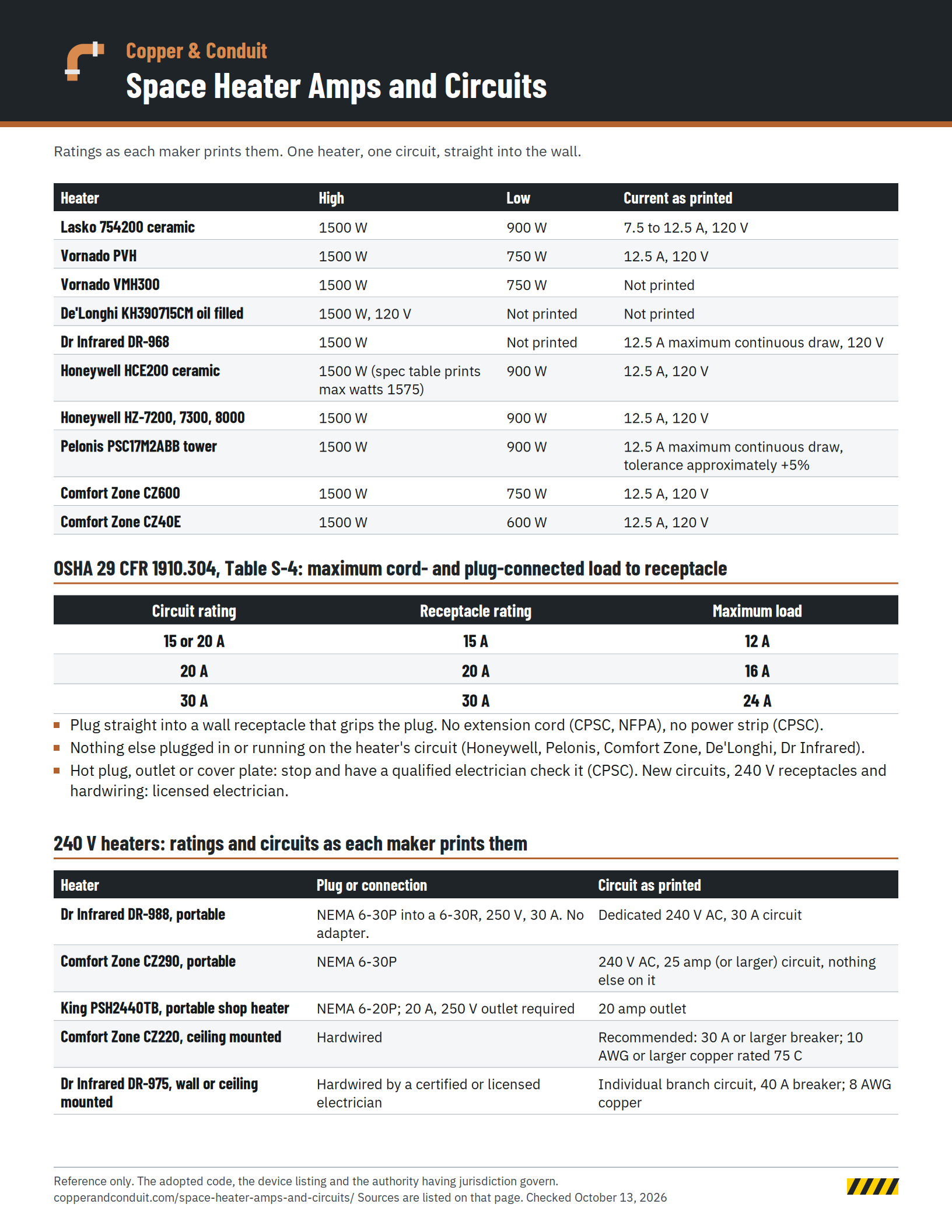
A 1500 watt, 120 volt portable plug-in heater draws 12.5 amperes. That is the figure printed by every maker on this page that prints a current. Plug it straight into a wall receptacle that grips the plug tightly, and run nothing else on that circuit while it heats. A 240 volt shop heater is a different job: the circuit and the receptacle or hardwiring its manual names, put in by an electrician.20 21 24 10 11 14 15 17 18 3 16
- Answers
- How many amps does this heater draw, and what circuit does it need?
- Format
- Spec chart
- Sources
- 26 cited
- Last checked
| Heater | High | Low | Current as printed | Plug |
|---|---|---|---|---|
| Lasko 754200 ceramic | 1500 W9 | 900 W10 | 7.5 to 12.5 A, 120 V10 | Polarized9 |
| Vornado PVH | 1500 W | 750 W | 12.5 A, 120 V11 | Polarized11 |
| Vornado VMH300 | 1500 W | 750 W | Not printed12 | Grounding, 3 blade12 |
| De’Longhi KH390715CM oil filled | 1500 W, 120 V | Not printed | Not printed13 | Polarized13 |
| Dr Infrared DR-968 | 1500 W | Not printed | 12.5 A maximum continuous draw, 120 V14 | Grounding, 3 prong14 |
| Honeywell HCE200 ceramic | 1500 W (spec table prints max watts 1575) | 900 W | 12.5 A, 120 V15 | Polarized15 |
| Honeywell HZ-7200, 7300, 8000 | 1500 W | 900 W | 12.5 A, 120 V16 | Polarized16 |
| Pelonis PSC17M2ABB tower | 1500 W | 900 W | 12.5 A maximum continuous draw, tolerance approximately +5%17 | Polarized17 |
| Comfort Zone CZ600 | 1500 W | 750 W | 12.5 A, 120 V18 | Polarized 2 prong18 |
| Comfort Zone CZ40E | 1500 W | 600 W | 12.5 A, 120 V19 | Polarized 2 prong19 |
Models are named for their printed ratings only. Copper & Conduit sells none of these heaters. No maker opened for this page prints a current other than 12.5 A for 1500 W at 120 V.
The receptacle load table
OSHA’s workplace rule: outlet devices shall have an ampere rating not less than the load to be served. Where a receptacle is on a branch circuit supplying two or more receptacles or outlets, it may not supply a total cord- and plug-connected load above the maximum in Table S-4. A single receptacle on an individual branch circuit shall have an ampere rating not less than that of the branch circuit. The 2005 NEC text carries the same table as Table 210.21(B)(2).1 2
| Circuit rating | Receptacle rating | Maximum load |
|---|---|---|
| 15 or 20 A | 15 A | 12 A |
| 20 A | 20 A | 16 A |
| 30 A | 30 A | 24 A |
Set beside the heaters above: the printed 12.5 A of a 1500 W heater is above the 12 A in the first row and under the 16 A in the second. The table applies where the receptacle is on a branch circuit supplying two or more receptacles or outlets; a single receptacle on an individual branch circuit falls under the rating rule above instead. None of the heater guides opened for this page asks for a 20 A circuit. Comfort Zone asks for a 120 V AC, 15 amp (or larger) circuit with nothing else on it; Dr Infrared, a grounded 120 V, 15 amp or higher circuit receptacle. OSHA’s table is a workplace rule; homes follow the electrical code the jurisdiction adopts. This page does not rule on whether a given circuit meets that code for a 12.5 A heater. That call belongs to your electrician and the local inspector.1 18 14
One heater, one circuit: what the makers say
- Honeywell and Pelonis: the heater draws 12.5 amps during operation. To prevent overloading a circuit, do not plug it into a circuit that already has other appliances working.16 17
- Comfort Zone: a 120 V AC, 15 amp (or larger) circuit, and nothing additional plugged into the same circuit.18 19
- De’Longhi: no other appliance plugged into the same outlet or into another outlet wired into the same circuit.13
- Dr Infrared: each heater and appliance should be on its own circuit.14
- Vornado: like any other 1500 watt heater it draws up to 12.5 amps. If the breaker or fuse trips on high heat, turn off other appliances on the same circuit, run the heater on low, or have an electrician add a circuit. Do not use more than one heater at a time.11
- Honeywell HCE200: the 900 watt low setting may be the better option if you are concerned about the amperage draw on a circuit.15
Cords, strips and the plug fit
- No extension cord, no power strip. CPSC: never power the heater with an extension cord or power strip. NFPA: plug the heater directly into the wall outlet; never use an extension cord. OSHA: power strips are not designed for high power loads such as space heaters.3 5 7
- The heater guides say the same. Lasko, Vornado, Dr Infrared, Honeywell, Pelonis and Comfort Zone all say to plug directly into a wall outlet and never to use an extension cord; De’Longhi says not to use an extension cord or outlet strip and to connect directly to a suitable outlet. Lasko adds surge protectors, multiple outlet adapters and cord reels to the list.9 11 13 14 15 17 18
- The plug must fit tight. CPSC: be sure the heater plug fits tightly into the wall outlet; if not, do not use that outlet to power the heater. Lasko: faulty wall outlet connections may cause the wall outlet to overheat.3 9
- Warm is normal, hot is not. De’Longhi: it is normal for the plug and cord to feel warm; an excessively hot or deformed plug or cord is not normal and may be the result of a defective outlet, which must be replaced before using the heater. CPSC: if the plug, outlet or faceplate is hot, stop using the heater and have a qualified electrician check or replace the plug or outlet.13 3
- A worn receptacle gets replaced by an electrician. Honeywell: contact a qualified electrician to replace a loose or worn outlet. Leviton lists three signs: cracks or chips on the face, plugs that are loose or fall out, and an outlet that feels warm or sparks.15 25
- Never run the heater cord under rugs or carpeting.3
240 volt shop and garage heaters
A different class of heater; two in the table are fixed heaters, not portable ones. Each maker below names the receptacle or the hardwired connection and the circuit, breaker or outlet it needs. The numbers are from each maker’s manual or spec sheet. A new circuit, a 240 V receptacle and any hardwiring are licensed electrician work; the breaker and wire sizes are printed so you can check a quote, not to install from.24
| Heater | Rating as printed | Plug or connection | Circuit as printed |
|---|---|---|---|
| Dr Infrared DR-988, portable | 5600 W, 240 V AC, draws 23.4 A20 | NEMA 6-30P into a 6-30R, 250 V, 30 A. No adapter.20 | Dedicated 240 V AC, 30 A circuit20 |
| Comfort Zone CZ290, portable | 4,800 W, 208 to 240 V AC, 20 A21 | NEMA 6-30P21 | 240 V AC, 25 amp (or larger) circuit, nothing else on it21 |
| King PSH2440TB, portable shop heater | 16 A at 240 V, 14 A at 208 V22 | NEMA 6-20P; 20 A, 250 V outlet required22 | 20 amp outlet22 |
| Comfort Zone CZ220, ceiling mounted | 5,000 W, 20.9 A, 208 to 240 V23 | Hardwired23 | Recommended: 30 A or larger breaker; 10 AWG or larger copper rated 75 C23 |
| Dr Infrared DR-975, wall or ceiling mounted | 7,500 W, 240 V24 | Hardwired by a certified or licensed electrician24 | Individual branch circuit, 40 A breaker; 8 AWG copper24 |
The King sheet prints 4,000 W in its ordering table and 3,750 W in its spec block, so no wattage is given for it here. Comfort Zone asks for a 25 A circuit for a heater with a 6-30P plug; Dr Infrared asks for a 30 A circuit for its 6-30P heater. Follow the manual for the heater you have.22 21 20
On the heater and in use
- A certification mark. CPSC: a certified heater will have a safety certification mark. UL: portable electric heaters are Listed under category KKPT, investigated to ANSI/UL 1278.3 6
- Tip-over protection. UL: Listed portable electric heaters must pass a tip-over test; makers may use temperature limiting controls or a tip-over switch to pass it. NFPA: make sure the heater has an auto shut-off that turns it off if it tips over.6 5
- Three feet of clearance. CPSC: keep beds, sofas, curtains, papers and clothes at least 3 feet (0.9 m) from the front, sides and rear of the heater. NFPA: at least 3 feet from anything that can burn, including people.3 5
- Off when you leave or sleep. CPSC: never leave the heater operating while unattended or while you are sleeping. NFPA: turn heaters off and unplug them when you leave the room or go to bed.3 5
- A short cord on purpose. CPSC staff: portable electric heaters are cord-and-plug connected with a maximum cord length of 8 feet; under UL 1278, SRDT and SPT-3 cord sets are limited to 6 feet.4
If the breaker already trips and you want to work out why, that is a diagnosis job. Our sister site walks it step by step: breaker keeps tripping at Vent, Valve & Volt.
Sources
- OSHA. 29 CFR 1910.304(b)(4), Wiring design and protection: outlet devices, Table S-4. eCFR, current as of October 13, 2026.
- Village of Schiller Park, Illinois. Section 210 NEC 2005 (NFPA 70, 2005 edition, Article 210): 210.21(B), 210.23 and 210.23(A)(1). 2005 edition.
- U.S. Consumer Product Safety Commission. Reducing Fire Hazards for Portable Electric Heaters, Publication 098. Undated.
- U.S. Consumer Product Safety Commission staff. CPSC Staff Assessment on Portable Electric Heaters (not reviewed or approved by the Commission). February 2023.
- NFPA. Electric Portable Space Heater Safety (safety tip sheet). 2018.
- UL. The Code Authority: Electric Heaters, Tip-over protection. Issue 1, 2009.
- OSHA. Standard interpretation: Compliance requirements for relocatable power taps or power strips. November 18, 2002.
- U.S. Department of Energy. Energy Saver: Small Space Heaters. Undated.
- Lasko. Ceramic Heater with Adjustable Thermostat, Model 754200, instruction manual. Rev. C 5/13.
- Lasko. Lasko 9 inch Ceramic Space Heater: Overheat Protection, 2 Heat Settings, Thermostat (Model 754200), product page. Undated.
- Vornado. Model PVH Whole Room Heater Owner's Guide. Undated.
- Vornado. Model VMH300 Whole Room Heater Owner's Guide. 2018.
- De'Longhi. Oil filled radiator KH390715CM, instructions (document 5710810901_00_0517). Undated.
- Dr Infrared Heater. Infrared Portable Space Heater DR-968, owner's manual. Undated.
- Honeywell. Ceramic Heater Model HCE200 Series, owner's manual. Undated.
- Honeywell. Energy Smart Cool Touch Heaters, Models HZ-7200, HZ-7300, HZ-8000 Series, owner's manual. Undated.
- Pelonis. Ceramic Tower Heater PSC17M2ABB, owner's manual. 2019.
- Comfort Zone. CZ600 heater, instruction manual. Rev. 05/24/2022.
- Comfort Zone. CZ40E heater, instruction manual. Rev. 05/27/2022.
- Dr Infrared Heater. DR-988 Industrial Fan Forced Heater, owner's manual. Undated.
- Comfort Zone. CZ290 Portable Industrial Heater, instruction manual. Rev. 05/20/22.
- King Electric. PSH Portable Shop Heater, spec sheet (PSH2440TB). Undated.
- Comfort Zone. CZ220 Ceiling Mounted Heater, hardwired installation, instruction manual. Rev. 06/10/2022.
- Dr Infrared Heater. DR-975 7,500W/240V Wall/Ceiling Mounted Garage Heater, owner's manual. Undated.
- Leviton. When should I replace an outlet?. Updated February 17, 2026.
- UL Solutions. Guide to Power Strips and Surge Protectors. Undated.